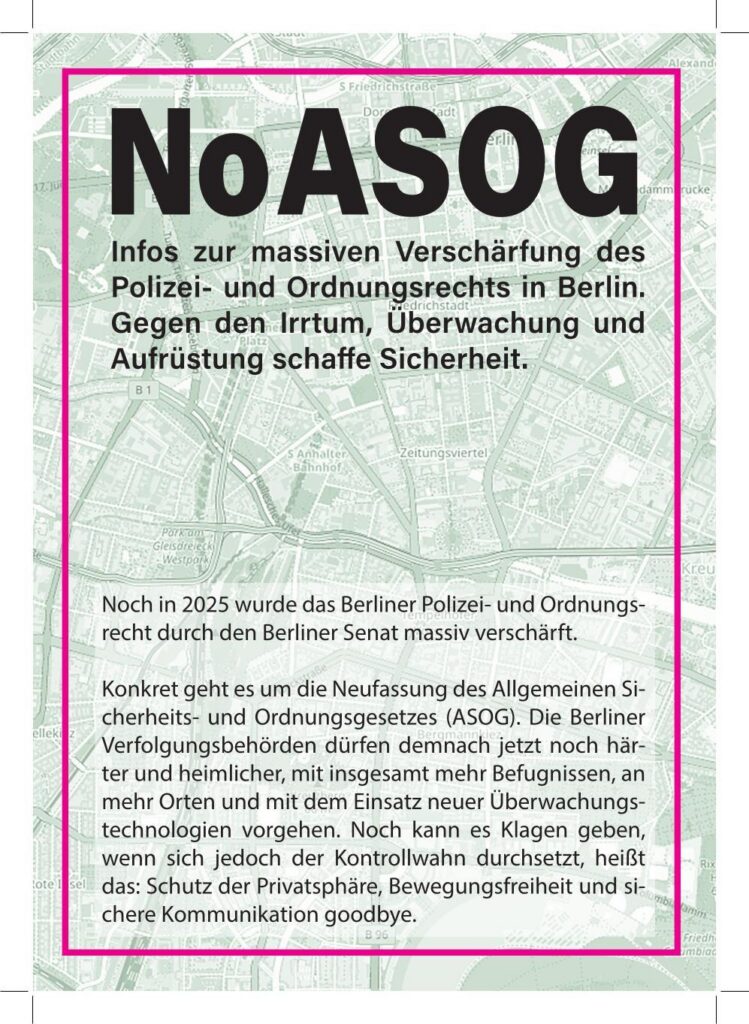
In the name of security, the Berlin ASOG is increasingly creating powers that enable police and security authorities to conduct nearly seamless surveillance of public spaces.
“Weapons and Knife Prohibition Zones”: In these zones, the police may briefly stop individuals, question them, inspect their belongings, and search them. The zones must be marked with signage. For such checks, no specific suspicion or special cause is required.
Currently, three areas around Görlitzer Park, Kottbusser Tor, and Leopoldplatz are designated as weapon and knife prohibition zones. Additionally, since recently, the entire Berlin public (local)transport system, including all rail services of the Brandenburg Transport Association within Berlin’s urban area as well as all train stations.
Crime-Prone Areas (KbO): In these areas, the police may conduct behavior-based identity checks, search individuals, and inspect their belongings. Here too, no specific suspicion or particular cause is required for such measures.
The new plans also call for the installation of 24-hour live video surveillance at these locations, with the footage to be analyzed by AI-powered software to identify “suspicious” behavior. There are currently seven such locations in Berlin (whose exact boundaries have now been published):
- Alexanderplatz
- Görlitzer Park/Wrangelkiez
- Hermannplatz/Donaukiez
- Hermannstraße/Bahnhof Neukölln
- Kottbusser Tor
- Rigaer Straße
- Warschauer Brücke
Vulnerable Objects: In Berlin, approximately 700 sites have been identified as vulnerable based on the State Security Service’s risk assessment. The plan is to expand the authority to capture and automatically analyze video and audio recordings to include interior spaces, associated parking lots, and other outdoor areas.
The specific sites are not publicly named. These include, among others:
• diplomatic facilities such as embassies and residences
• Jewish institutions such as synagogues, schools, and kindergartens, as well as
• federal and Berlin state government facilities.
AI-supported video surveillance systems are now also to be installed at the Rotes Rathaus (Red City Hall), the Old City Hall, and the House of Representatives.
Public (large-scale) events and gatherings not subject to the Freedom of Assembly Act: These include events of all kinds, such as street festivals, markets, or sporting events. Here, too, personal data of participants is to be collected and processed in the future through video and audio recordings.
Additionally, data collected by event organizers themselves may be utilized.
At demonstrations and rallies, video and audio recordings will also be made using drones in the future.
Critical infrastructure, such as energy facilities, utility infrastructure, or bridges, and even Berlin’s public swimming pools, will also be subject to video surveillance in the future.
Recordings from dashcams and bodycams (worn by police, fire department, and emergency medical service personnel, as well as by field staff of district public order offices on uniforms and vehicles): Their use is now to be generally permitted for “danger prevention.” Filming is also to be permitted during operations in private residences under certain conditions.
Taken together, this would lay the groundwork for virtually comprehensive surveillance across Berlin.